Dawn - Sometimes An Ultrarunner

Dawn - Sometimes An Ultrarunner

February 9, 2008

Tinum...Our House

I know that there are a few of you out there that have been asking for years for pictures and descriptions of our house down here in Tinum. I have been busy painting the bathroom and ceilings and applying varnish to the shelves and doors in the living room, and Rob of course decorates the house with a master's touch. And since we had a longer time here this year, we got into a few cement projects as well. So now I have finally taken some good pictures of our newly upgraded abode, and I will give you a tour of our refuge amidst the madness that is Tinum. The front of the house can only be entered by the gate, which we just replaced with a new, strong wooden one, or by the front door, which opens to the kitchen. In the kitchen we have a small refrigerator and a gas stove, and several mesh-sided cabinets to keep bugs out of our food. Outside the kitchen is a small thatched palapa, were we can sit and eat in the shade.

The main room is where we hang out, entertain guests, and sleep. At night I hang my hammock out and sleep in it, otherwise it is out of the way. Almost half of the main room is a walk-in closet, which is our only closet, used to keep everything we have off the floor and out of the reach of animals. The inside of the house stays cool by using a unique system of air holes in both the roof and walls, and rain is diverted from entering because of offset openings. The windows to the front of the house are old glass mayonaise jars, which offer light but no direct view of the inside. In fact, there is no way to see out to the front without opening the front door, which handily defends us from many curious kids outside.

Off to the the side of the main room is the garage, so named because somebody once upon a time kept a car in there. Now the huge doors are rusted and we never open them, and it has become a storage area for the tools and misc stuff that has accumulated over the years. To the rear of the house is our biggest room, which we call the sala, and it was the original house that Bettina lived in while the rest of the house was being built. We keep our bikes on one end, and sometimes guests sleep on the other end, otherwise it is a good place to take a nap in the heat of the day. There are two huge openings on each side of the sala, each with three wide doors that swing up to let the breeze in. The carpenter in town just recently built new mesh doors to replace the original vine-covered ones, which after 30 years were slowly falling apart.

About 50 feet from the house is the bathroom. The bathroom is where we do the laundry, wash the dishes, and of course take showers or sometimes bucket baths. The only running water we have is a faucet in the middle of the yard, and the city water comes on in the morning and again in the evening. When the water is on, we fill buckets and carry them up to the roof of the bathroom to fill the tank, which we use to take showers. We also keep many buckets of water inside the bathroom to flush the toilet. The wood outside the bathroom is used to heat a small tank of water, which pipes hot water to the shower. Out in the back yard we have many flower beds and cactus gardens, which we are always slowly filling with various plants. Each year in the dry season many plants die if we aren't around to water them, and of course in the wet season the undergrowth takes over and makes it a jungle again. It takes days of chopping each time we return, to clear out the weeds so we can see the plants and flowers again. But overall it is a lot of fun for us to create a little beautiful space that we can call our own. So there you are...our house. Come see it for yourself someday!


February 6, 2008

Tinum...Let's Have Chicken For Lunch!

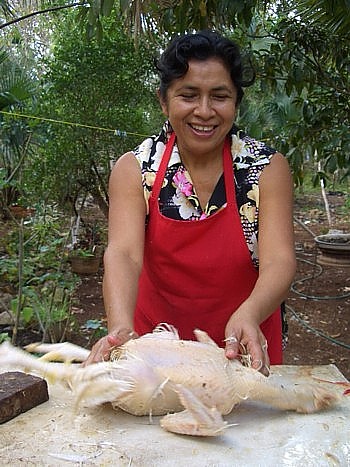
A big part of what makes the food taste soooo good here is that it is usually very fresh. Fruits and vegetables are picked straight out of the garden or the trees. In several places around town, men get up before dawn every day to kill a pig, and the meat usually sells out shortly after daybreak. In most people's yards there is either a chicken coop or just poultry and turkeys roaming around loose. However, not everyone keeps chickens, and so there are also several women around town that sell chickens, not at dawn, but really anytime of day. Doña Sari is one of those, and we followed her through the process of selling a chicken. Several times a week, a truck comes around and refills her small chicken coop so that she always has more to sell. Then she waits for someone to show up and want a chicken for lunch.

They know that they will have to wait about ten minutes for the finished product, but they also know that it is worth the wait. Many people in the village have grimaced and shaken their heads after hearing that in the United States, it is typical to buy all kinds of meat either frozen or refrigerated at the grocery store. Anyway, Doña Sari heads out to the chicken coop, grabs a chicken, and ties its feet to a hanging rope, and deftly slits its throat or cuts out its tongue with a knife. We set the timer on our watch. After it bleeds out in a few minutes, she removes it from the rope and dunks it in a pot of hot water that she always has heating over her fire. After it is good and hot, she dunks it in a cooler pot so she won't burn her hands. On a small table, she plucks all the feathers, removes the entrails, toenails and whatever unedible pieces that there are, and then gives it a good wash. On a different table, she chops it into halves, and weighs out the amount that the customer wants. Into a clear plastic bag, and out to the customer, fresh chicken in less than 10 minutes.


February 3, 2008

Tinum...Taking Out The Stones

One of the coolest things here is that all of the materials that it takes to build a thatched hut are out in the forest, waiting to be found. Many families here proudly bring us into their houses and show us that they have used only what they can find or make from natural materials, and in some cases, the natural stuff lasts longer and works better than imitation materials. Of course, some houses are made from cement blocks with tin roofs and are nailed and cemented together and everything must be purchased from the city. But a palapa, or thatched hut, can be built from felled trees, topped with palm leaves, and tied together with vines. Even the floors in many cases are still just dirt. And it was the floor that we were going to help with at a neighbor's house down the street. This particular family had plans of having a big party at their house spanning a whole week, and needed more room for guests to work and eat in, so they were hurrying to finish the roof and floor of a new palapa. The frame was already there, consisting of four poles supporting an oblong roof with rounded ends. The floor was mostly just an empty space, and around the edges of the would-be floor were large rocks, meant to be a boundary for the floor. To help keep it flat and even, strings had been run around the edges and across the middle.

Our job was to fill this 10ft x 20ft space with about 8 inches of rocks, first larger rocks on the bottom, and then smaller and smaller ones, until finally it would be topped with just dirt. A corner had already been filled in to show us the correct method. When we asked where we would find such rocks, the women pointed around their yard, and said "Take whatever rocks you can find." So we set out to gather rocks, using a couple of old 5-gallon buckets to transport them in. The yard was on a small slope, so the back was maybe 10 feet taller than the front. The slope was entirely one huge porous limestone rock, so we literally just pulled rocks out of the ground to fill our buckets. One of the men helped us out, placing and leveling the larger rocks around the edges. We pulled rocks from everywhere, even their old burn piles and around the pig pen. As finding the loose rocks got sparse, he actually took a pickaxe and started chopping into the dirt and stone to pull out more and more rocks of all sizes. It was backbreaking work, and we were soon hot and sweating from the sun and the weight of the filled buckets. As the morning wore into afternoon, our breaks started getting longer just to recover our strength and stop sweating so much. But, after four hours of work and probably 100 buckets full of rocks, the floor was level full with rocks and ready for the dirt top. And even better, lunch was ready...we had watched and smelled the process of killing and cleaning and grilling the chicken, and cutting vegetables to cook in broth over the fire. I even tried my hand at patting corn tortillas, because that is something every woman must know how to do. So for our starving tired bodies, chicken soup with handmade tortillas and a sweet rice drink was the best food we had ever eaten, plus the knowledge of a job well done.


February 2, 2008

Tinum...Taking Out The Bones

On this particular Sunday morning, we woke up early to be at the graveyard at 7 a.m. It was the 4 year anniversary of the death of an older man from a family we knew, and today they would be digging up his bones to move them to a smaller box. It was cheaper for the family to only pay for space for 4 years, and then make a smaller box along the edge of the graveyard that would be permanent (and also so the hole could be reused for someone else, because space was limited in the graveyard).

The whole family was there, dressed more or less in nice clothes, discussing where the new box would go and how big of a mausoleum should be built. The gravedigger showed up at about 8, and set to with his pickax. The grave was covered with a shallow layer of cement, held up with a layer of sticks and logs. Underneath, sometimes they were filled with dirt, and sometimes just the box with the body is lowered into the ground and left as is. As the gravedigger (who had removed his shirt to keep it clean and to expose his beer belly) removed more and more of the cement, the family began to inch closer and closer in a circle around the grave. The gravedigger removed chunks of cement and logs,  without any ceremony, and chucked them over the nearby cemetary rock wall. When the open grave was fully exposed, he jumped into the hole and peeled back the bag that had held the body (unlike the typical box made by the town carpenter, this was almost just a body bag) to expose the head, which he then covered with a white cloth.

After a short Coke break, he jumped back in the grave to remove the bones. First came the head, which was still sort of mouldy black color rather than a nice bleached white, and another pass to grab some of the hair that had fallen off. Then the rest in succession, shoulder blades, ribs, spine, arm bones, etc. Each bone got a perfunctory wipe with a white cloth before being placed into a little cloth-covered box, which did nothing to make them seem cleaner, they still looked very black and greasy. He even gathered all of the finger bones, almost seeming to count them to see if he found them all, digging around in the cloth and dirt and shirt that had covered the corpse. The leg bones he had to pull out of the pants that still seemed almost wearable.


Finally all the bones were inside the box, and it was taken to the little shack that served as an office, to keep until the new place was built. At that, everything seem to be over, and with a last stare into the hole, everyone started drifting off. I wondered what they were going to do with the wrappings that still lay in the grave, and at that, the gravedigger came back, gathered up the clothes into a bundle, and with absolutely no ceremony, threw them over the graveyard wall. Then it really seemed to be over, until one of the men remembered that he had a wart and needed some of the dirt from the body to put on it (as per the local tradition to cure warts). After some discussion, he considered jumping over the wall to dig in the coverings, but then had a better idea. He went to the shack, removed the top of the box (which had been quickly nailed on) and rubbed some of the bone grease over his wart, and then put the top back on. And as we were all leaving, I could see the other side of the rock wall, which held growing piles of....broken cement and body bags.

February 1, 2008

Tinum...The Journey Of The Leaf-Cutter Ants

All sorts of interesting creatures seem to hang out in the backyard here, some showing up in odd places at odd times. The leaf-cutter ants may be the best example of the unexpected that I have found so far. One night as I was walking out to the bathroom about 11 p.m., the glow of my flashlight picked up a trail of green leaves that had not been there before. I knew that for sure because I had just finished raking the leaves from the path just a few hours earlier. Plus, these leaves were still green. As I crouched closer to see what it might be, I picked up the movement of hundreds of ants, and I quickly moved back to make sure none of them could reach my feet, because I have been told that the bite of these ants can really hurt. But except for the narrow trail of ants carrying leaves, there seemed to be very few stray ones, and I peered closer. As I watched them move, they seemed to have a collective purpose which made them focus dilligently on the task at hand, which was to climb a very tall tree, cut the green leaves into sections, and then carry them home. As I stood there watching, a green leaf actually fell out of the tree onto their path, and an ant approached it, slowly cut an abstract corner off of it, and then wandered off and left the pieces laying on the ground. In fact, hundreds of cut leaves actually lay on the path, as ants climbed the tree to cut leaves, and then slowly returned with their bounty on their backs. I wondered if they would leave the fallen leaves on the ground, or eventually pick them up. Other ants seemed to be trying to clear the path a little, as their trail lay up and over the fresh pile of leaves I had raked. A few of them were trying to move dry leaves out of the way of the masses. I followed the ants with my flashlight over my leaf pile and down to the backyard, careful to never step on the narrow trail. Several hundred feet later, their path went through the rock fence and into the neighbor's backyard, and I declined to follow them further, but was estimating that each ant only would have time to make only a couple of trips in the course of a night, if that much, since they didn't move during the day. But they were focused on their green prizes, and even when I picked up a leaf, an ant stayed attached to it with waving legs, waiting until I put it back on the trail to continue walking the long way back their anthill. And the next morning, when I woke up and made another trip out to the bathroom, the ants were gone, and not one green leaf remained on their trail.